My overseas work contract recently concluded, but after three years of vast Australian skies and wilderness at my doorstep, I couldn’t bear returning to the congested mid-Atlantic sprawl I’d once called home. Instead, I took a job in another remote pole:

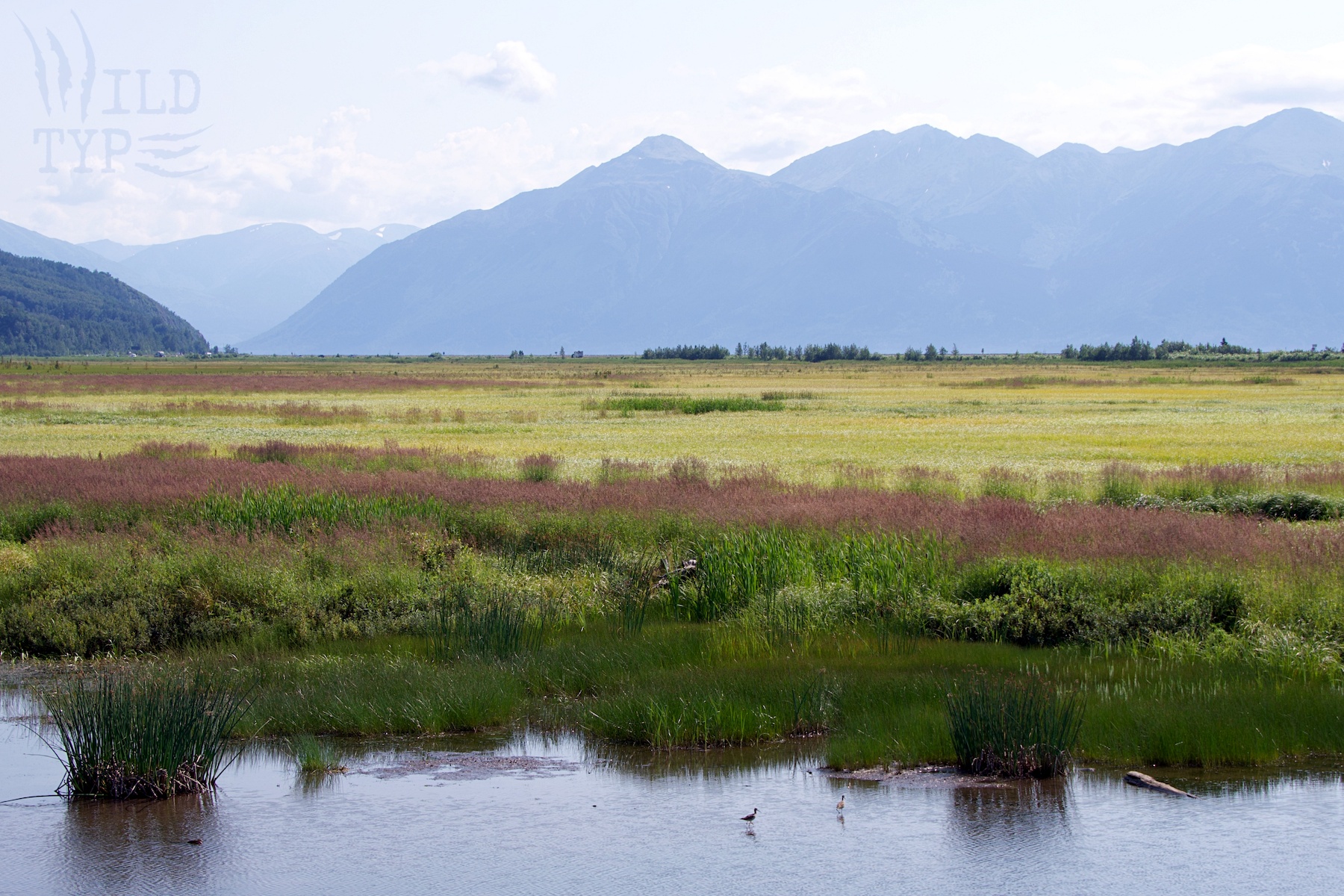

Alaska! I’ve hopped hemispheres from the Great Southern Land to the Great White North.
“You’re going to Alaska?” My Australian colleagues gasped, echoing the words of American friends when I’d departed for Australia. “But everything there can kill you!” Yes, running with an 8-ounce can of bear spray strapped to my hip will take some getting used to. But proximity to nature is part of the reason I came. An endangered population of beluga whales reside in the Cook Inlet. Shorebirds congregate in the wetlands and ponds. Moose forage along popular public trails, bringing traffic to a halt. Setting out to explore Anchorage’s parks, I couldn’t wait to embrace the wildlife.
I didn’t expect to do it literally.
“I saw an owl,” my Laddie announced upon returning from a sunrise run. (After his adventure-ending ACL tear last year, I’m thrilled to see him back on the trail.)
“Did it swoop you, like that one back in Maryland?” I asked, with a nervous chuckle. That neighborhood barn owl had not appreciated pre-dawn runners passing through its territory, and had nearly made its point on my Laddie’s ear, much as an Australian goshawk had with mine.
“No, it was just sitting in a ditch on the side of the road.”
I stopped, coffee pot suspended over my mug. “Was it hurt?”
“I don’t know. It looked pretty chill.”
“Well, let’s go back and check on it after breakfast. We’ll bring some rescue equipment just in case.”
Living out of suitcases left us without our usual tools for the job, but we scrounged up the best kit we could. Thin running gloves instead of work gloves. A promotional shopping bag from Costco in lieu of a cardboard box.
“Here’s an owl towel,” said my Laddie, slipping me one of the fluffy white linens stacked in our AirBnB bathroom. I winced at the thought of wrapping a muddy, bloody creature in it, but we had nothing else to use. Hopefully the bird wouldn’t even be there—much as I longed to see it, its presence wouldn’t bode well for its condition.
We drove back to the site and searched the roadside. Yellow eyes flashed amid the clover: a basketball-sized owl with striated grey and black plumage. Tufts of feathers (properly termed “plumicorns”) extended like ears from either side of its facial disc.
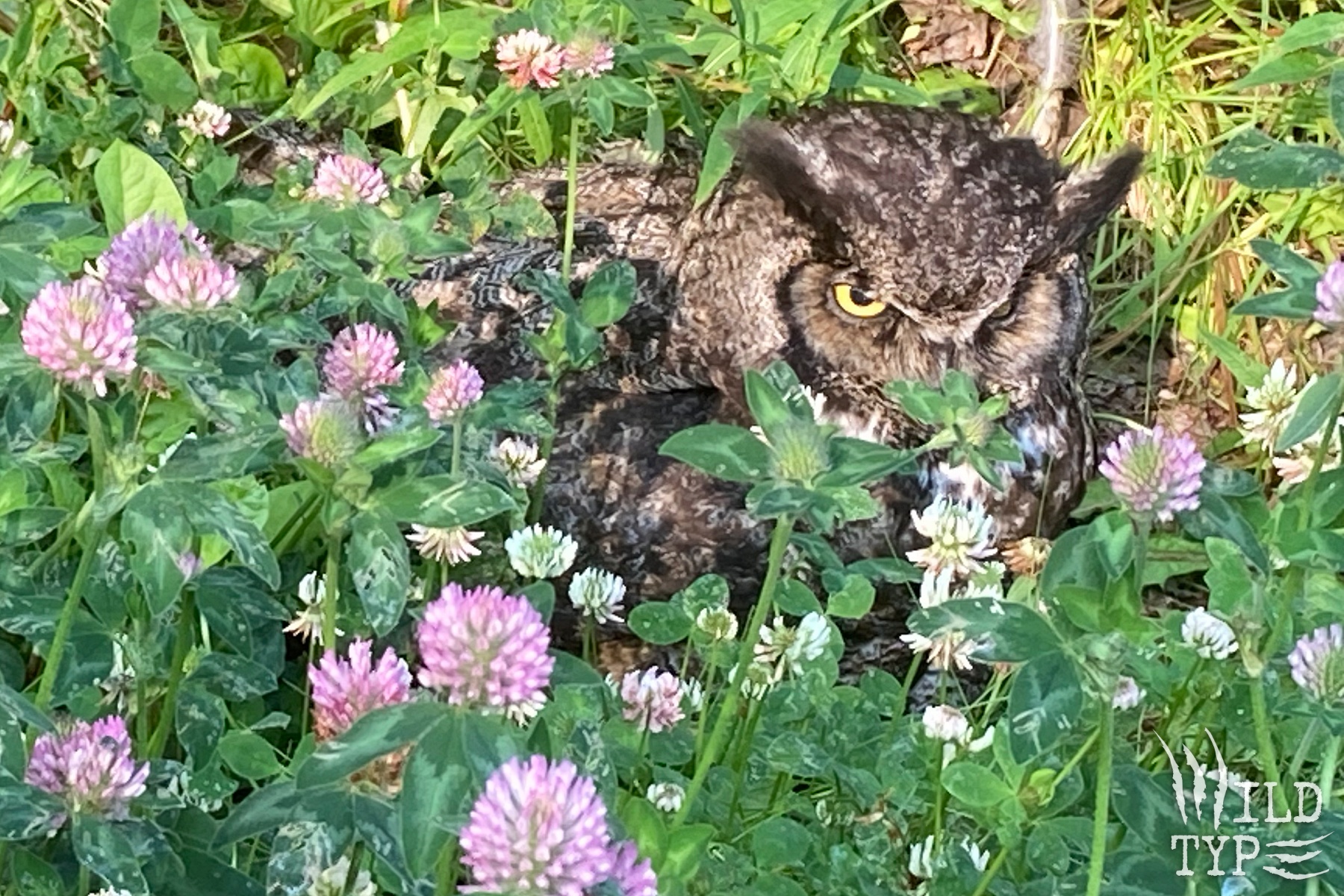
“It’s a great horned owl,” I breathed, crouching for a better look. I hadn’t seen a wild owl since the boobook family two years ago. This bird had a far sterner aspect than those sweet-faced aliens. One wing appeared ruffled, and a few stray feathers littered the grass. “Looks like it might’ve gotten clipped by a car.”
I called the local bird rehab center. A recorded phone message informed me they were closed on Saturdays. “Like birds don’t get hurt on Saturdays!” I fumed, searching for another option. I finally connected with a human at a facility an hour north, who pointed out that someone had to be at the Anchorage center, caring for the birds. “I’ll go knock on their door until they answer,” I vowed.
Seemingly touched by my determination, she advised me on how to handle the bird. Some of the instructions were familiar to me from previous rescues: “Go from behind and cover it with a towel. Once it’s contained, unwrap its head.” Others were more species-specific: “Hold its legs so the talons can’t get you!” And all I had was a filmy pair of UnderArmour gloves. Great.
I turned my denim jacket frontways like a dentist’s x-ray apron; at least the tough fabric would afford some protection. My Laddie held open the bag while I approached the owl, crooning softly to it. I held my breath as I tossed the towel, expecting chaos. But the owl hardly stirred. That worried me. Even the mortally wounded koel I’d rescued in Australia had tried to escape. Clasping its thickly feathered legs, I nestled it into the bag. Although great horned owls are the second-heaviest owls in North America, it felt light in my arms. I’m always astonished at the ferocity of creatures made of hollow bones and fluff!
I whisked our patient down the Seward Highway. Thankfully, there were plenty of staff at the rehab center site. Like me, they expected feathered fury when I told them I had a great horned owl, but the bird went meekly. I gave them a $20 donation. Later, ordering a replacement towel, I had to drop another $30 on a three-pack. That seemed fortuitous when we had to leave the AirBnb a few weeks later: our shipment of household items had been delayed in transit, leaving us to move into our new rental with naught but suitcases.
“Good thing we have those spare Owl Towels,” I told my Laddie as we unpacked. “Where’d you put them?”
He stared at me. “I thought they were replacements.”
“Only one was. The other two are ours.”
“I thought you had them.”
“You washed them!”
“Yeah, and put them back in the linen closet.”
“You gave all our towels to the damn AirBnB?” I shrilled. It sounds trivial, but when you lack so much as a spoon to eat your breakfast cereal, forfeiting a towel is a blow. “That owl better have lived—it cost me fifty dollars!”
The absurd pettiness in my ears dissolved my ire. If the Angel of Bird Rehabilitation had appeared in that ditch and offered to save the owl’s life for $50, I’d have opened my wallet without hesitation. But removed from the immediacy of crisis, bean-counting had blinded me to that bigger picture. Discomfort prickled my neck: so this is how governments and industries continually fail to invest in solutions to climate change.
Self-extinction aside, letting climate change run rampant is an expensive prospect. The National Centers for Environmental Information calculated that U.S. weather and climate disasters in 2021 cost $145 billion. The next year’s total rose past $165 billion. Scenarios developed in 2019 projected that a temperature rise of 4.5˚ C by the year 2100 could cost the U.S. $520 billion each year, more than twice the anticipated cost if we keep the mercury below 2.8˚ C. Unconstrained global warming could cause a 20% drop per year in the world’s GDP by 2050, according to a British government report.

What would it cost to mitigate such devastating effects? Those numbers are more difficult to forecast, but we can get a sense of comparative scale from particular projects. For example, helping front-line nations such as Caribbean and Pacific islands adapt for climate change could cost anywhere from $56 billion to $300 billion by 2030, according to the United Nations Environment Programme. (Even the high end of that estimate is less than America paid for the last two years of climate-related events.) Although the U.N. estimates that global resiliency efforts will ultimately exceed $500 billion per year, “shifting to a green economy could yield a direct economic gain of $26 trillion through 2030 compared with business-as-usual.” The up-front investment pays off not only financially, but existentially. It’s hard to put a price tag on our planet.
Yet we as a civilization continue bickering over a metaphorical $30 worth of towels, too fixated on short-term outlay to see the grander conservation goal. My travels make me a witness to the compounding costs of inaction. Wildfires dashed my hope of driving across Canada to Anchorage, evoking the Black Summer bushfires that razed Australia shortly before I arrived there. Only a few sunny days graced my first month in Alaska; locals bemoaned the atypical rainy pattern dampening their brief and precious summer. Unusually wet weather characterized my time Down Under, too, with floods ravaging the country’s northeast. Everywhere I go, the elements are in revolt.
And everywhere I go, I’ll continue doing my puny-human best to protect nature, no matter how many towels it takes.
 Wild Type