I entered my office and walked straight into a cloud of bats. Cartoonish chiropterans clung to the walls. Orange crepe shrouded the doorways. A plastic mermaid skeleton with blue nylon hair dangled from the light over my desk. My grinning colleague animated a large, fuzzy spider perched on the cubicle divider. “You think that’s going to scare me when I just spent three years living in Australia?” I asked. What scared me was the waste. Not just the project time my coworkers had squandered decorating for Halloween, but the materials themselves. How much harmful trash does this holiday generate? Back home, a little online investigation unearthed some frightening facts.
It took more digging than I expected. My first search engine query on “Halloween decoration waste” turned up retail links for toxic waste-themed lawn decor. I don’t recall such elaborate trappings during my suburban trick-or-treating in the 1990s: besides jack-o-lanterns, houses displayed little more than homemade ghosts or scarecrows made from old fabric. Thirty years later, Halloween has mutated into a commercial monster. Consumer spending on related items hit an all-time high of $10.14 billion in 2021 (we won’t get into what the Agricultural Marketing Research Center terms “the pumpkin spice industrial complex”, a $600 million market in 2018). That’s a lot of decor, costumes, candy, and pumpkins, all of which pose environmental issues.
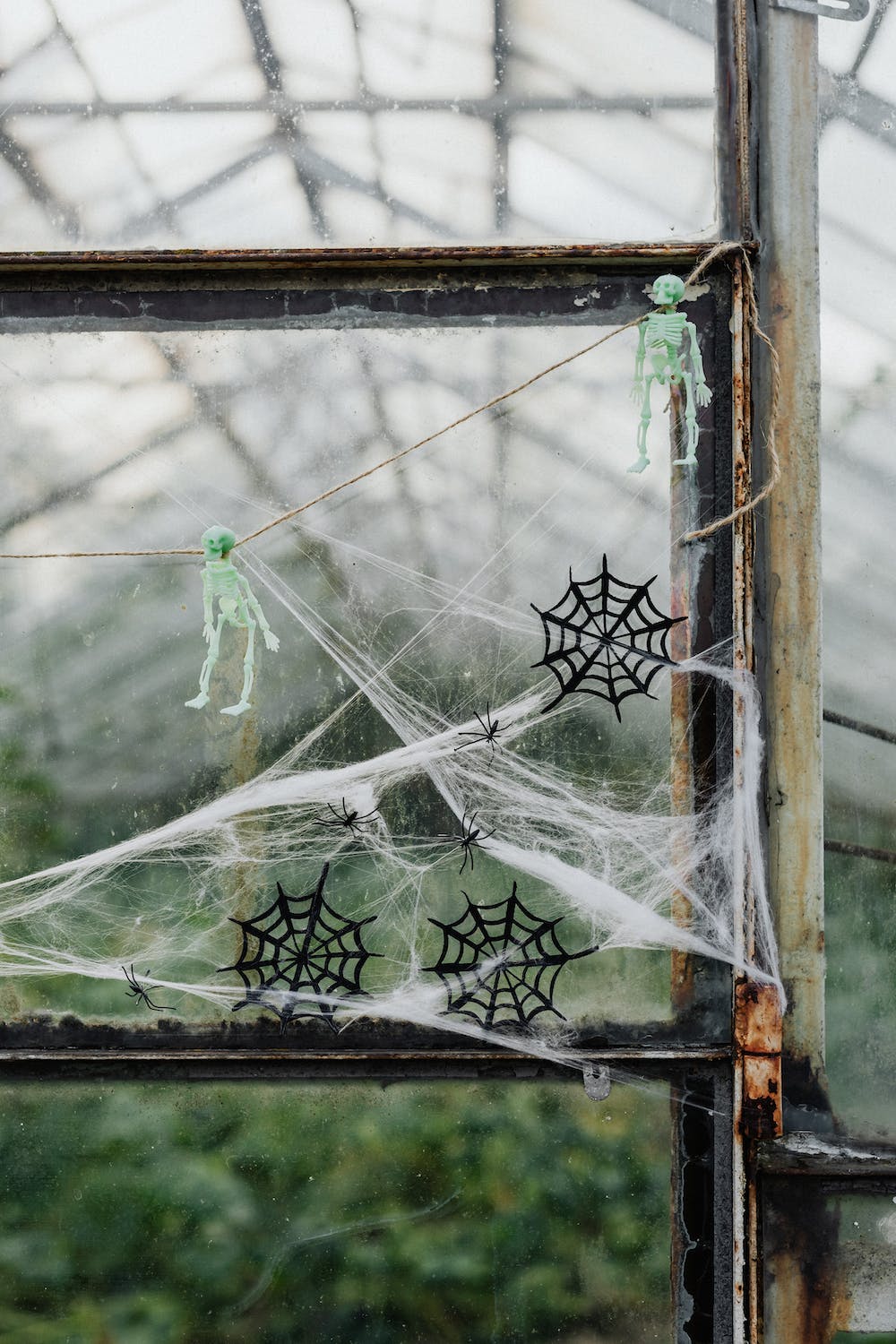
The deadliest decor in your neighborhood this Halloween might be artificial cobwebs. Fake spider silk on trees and shrubs can ensnare birds, pets, and ecosystem-vital insects like bees. Every year, wildlife rehabilitation centers treat birds injured in encounters with this unnatural substance. Longer-term, fake tombstones and skeletons undoubtedly contribute to the 29 million metric tons of plastic entering the environment each year. Plastic also hides in more insidious places. A 2017 study conducted in the United Kingdom found that more than 83% of the material in commercial Halloween costumes contain oil-based plastic like polyester; worse, almost half of the outfits were worn only once. Brits bin about 7 million costumes per year. If that ratio holds for the United States, with five times the UK’s population, that’s about 35 million costumes.
What if you skip the costumes and go straight for the candy? Trick’s on you: plastic lurks there as well. “A single trick-or-treater generates one pound of trash at Halloween,” Halloween historian Lisa Morton told Marketplace in 2021. “When you consider that we have over 40 million trick-or-treaters, boy, that is a lot of trash.” Containers and packaging made up 21% of landfill trash in 2018, according to the U.S. Environmental Protection Agency, and those cute single-serving “fun size” products add more than their share. Candy manufacturers acknowledge the problem. Mars, producer of trick-or-treat staples like Twix and M&Ms, recently began collecting used wrappers for conversion into dog-waste bags. It’s a nice thought, but this low-value plastic product doesn’t recoup the cost of recycling, and only addresses a fraction of the candy waste conundrum.
What’s inside the wrapper can be scary, too. Many Halloween treats are made with palm oil, a unsustainable resource driving deforestation. Oil palm plantations—monocultured “green deserts” devoid of biodiversity—currently cover more than 27 million hectares of the Earth’s surface. Clearing jungles and peat swamps for farmland, plus intense fertilization for high crop yields, releases tremendous amounts of greenhouse gasses. A 2020 study found that emissions from palm oil plantations in south-east Asia was equivalent to almost half that of global aviation emissions. Mars is making a token effort here, too, with a “Palm Positive Plan” that promises to source only deforestation-free palm oil. While it’s a step in the right direction, the deciding factor rests with consumers. If we don’t buy it, they won’t sell it. Drive more environmentally friendly practices by choosing palm-oil free candies for your Halloween sugar fix.
Or better yet, eat a pumpkin. Of the 2 billion pounds of pumpkins U.S. farms produced in 2014, 1.3 billion were thrown away uneaten. Decomposing in landfills, the junk-o-lanterns release methane that contributes to climate change. This becomes a perverse feedback loop as climate change threatens global food production: the more calories we discard, the fewer we’ll have in the future. What if we used it now? A pound of pumpkin makes one cup of puree, two of which fill an average pie. Rough math suggests that those pumpkins Americans tossed in the trash could have produced approximately two pies for every person in the country. If pie isn’t not your thing, try a curry or these scrumptious muffins I baked this weekend. Since Halloween evolved from a pagan Celtic harvest festival, it’s fitting to celebrate nourishment from the Earth.
We can nourish Earth, too, with smarter seasonal celebrations. Halloween isn’t the only wasteful holiday. A blizzard of disposable decor accompanies Christmas; candy smothers store shelves at Valentines Day; and eggs wasted at Easter might rival the Great Pumpkin Pitch. Retailers will pounce on any calendar occasion to make a buck (remember Wal-Mart’s controversial Juneteenth ice cream?). But these indulgences cost more than just dollars. We pay for them with our planet’s chance at survival. From this perspective, Halloween plays a sublimely ironic trick: our pursuit of spooky amusement accelerates the true horror of ecosystem collapse.
 Wild Type