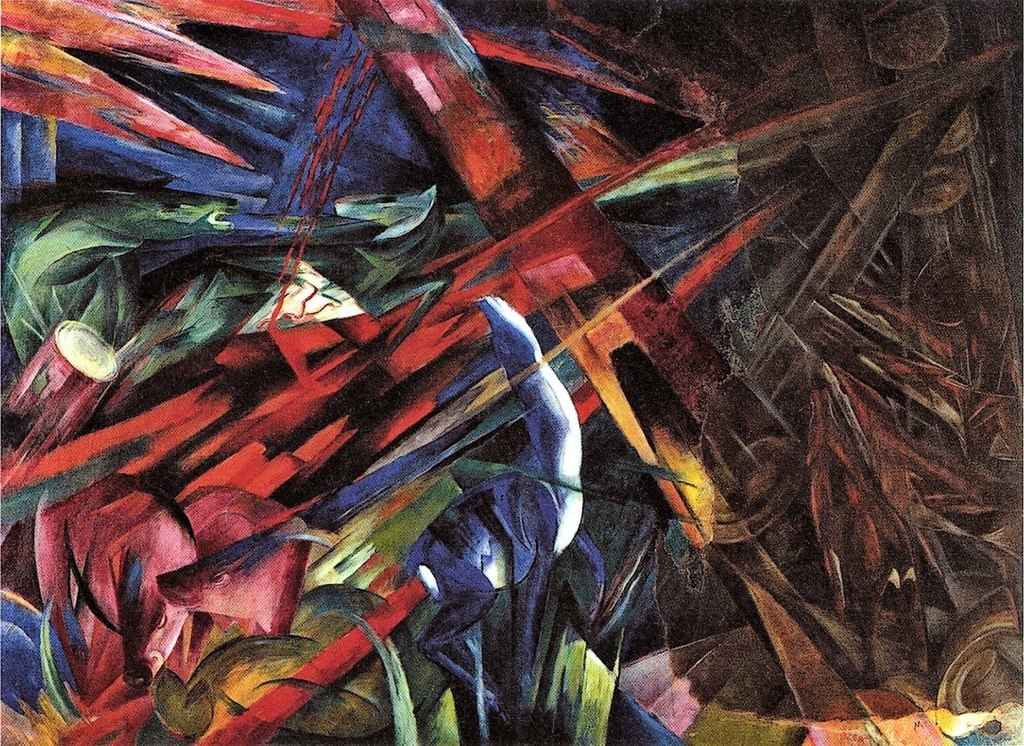
Red leaves, but no red cardinals. Blue sky, but no blue jays. “Maybe I shouldn’t have bothered packing my camera,” I grumbled to the autumn leaves overhead. Back in my hometown for a visit, I’d hoped to photograph favorite childhood birds, but some species seemed sparser than I remembered. New construction had further reduced their habitat. I satisfied my treasure-hunting urge in a used bookstore instead and found a Mary Oliver anthology. Her poem Blue Horses sent me down on a research rabbithole about the artist who’d inspired it, German expressionist Franz Marc. Browsing through his pieces, the hues of absent cardinals and jays leapt out at me from one called The Fate of the Animals.
Painted in 1913, the image depicts wildlife caught in a geometric holocaust. An inscription on the back reads “And All Being is Flaming Suffering.” Art historians traditionally frame it as a reflection of the atmosphere before World War I (Marc himself was drafted into military service and killed at Verdun in 1915). More than a century later, however, it strikes me as a premonition of the sixth extinction. Species decline extends far beyond my old backyard. Nearly a fifth of European species are at risk of extinction, according to a study published last week in the journal Plos One. Of nearly 15,000 species researchers analyzed, extinction threatened 27% of plants, 24% of invertebrates, and 18% of vertebrates. Extrapolating from these numbers suggests two million species are at risk worldwide, double the previous estimate. Habitat loss, pollution, and resource depletion have splintered the environment like the fiery bolts across Marc’s canvas.
Rice’s whale embodies this tragic trajectory. Only about 50 individuals remain, clinging to existence amid marine traffic in the Gulf of Mexico. Ships hit them, and underwater noise stifles their communication. Simple measures could help: a lower speed limit for large vessels would reduce both collisions and engine noise, while technology adaptations can make loud survey equipment up to ten times quieter. But commercial interests have rejected the ideas as too expensive. A Republican representative from Louisiana blocked a speed limit bill, pending proof that it wouldn’t adversely impact commerce. The president of a seaport industry group told NPR it would be “wildly overbroad and ill-conceived to force a blanket slow-down if there’s only so many [whales]. And time is money, of course.”
Such rank greed and devaluation of animal life would likely have appalled Franz Marc, who disliked the “progress-hungry spirit of modern centuries.” With the human population projected to exceed 9 billion by 2050, consuming ever more of the planet for food and fuel, we need a strategy for sustainable civilization. Earlier this month, an international team of scientists proposed a new habitat conservation method that could dramatically reduce species extinction risk. Current approaches focus on safeguarding a fixed percentage of land without accounting for localized populations.
Yet small areas can have big impacts. For example, Australia’s Lord Howe Island represents only a fraction of the providence petrel’s global range, but it’s one of only two locations where the seabirds breed, making it critical importance for overall species persistence. Researchers integrated more than 70,000 population maps for 861 endangered terrestrial mammals to identify “priority habitats”. Shifting protections to those spots doubles the animals’ chance of survival, their paper in the journal One Earth asserts.
Programs like this could slow the precipitous loss of Earth’s biodiversity, if we find the courage and compassion to act. Franz Marc sought “to heighten [his] sense of the organic rhythm of all things, trying to empathize pantheistically with the shivering and coagulating of blood in nature, in trees, in animals…” Empathy flows more readily when we recognize the same blood in our veins. Water where rare whales swim hydrates our bodies; air that shapes a common songbird’s melody animates our lungs. Technological sophistication cannot disentangle us from the ecosystem, and it may not save us from the looming cataclysm. We will share the fate of the animals. So what will we let it be?
 Wild Type