After researching how climate change threatens snowy Arctic biomes, I’ve been spending as much time as I can outdoors in the Alaskan winter. A recent 20-Fahrenheit afternoon felt warm after December’s negative temperatures. My neighborhood stream, artificially heated for utility purposes, burbled along with less ice than usual encrusting its rocks and reeds. Birds took advantage of the liquid water for baths. A Western Blue Jay waded into the current, black and indigo plumage mirroring the frigid water, and dunked. Droplets ran down its sleek back. After a thorough dousing, it repaired to a spruce tree and preened in private.

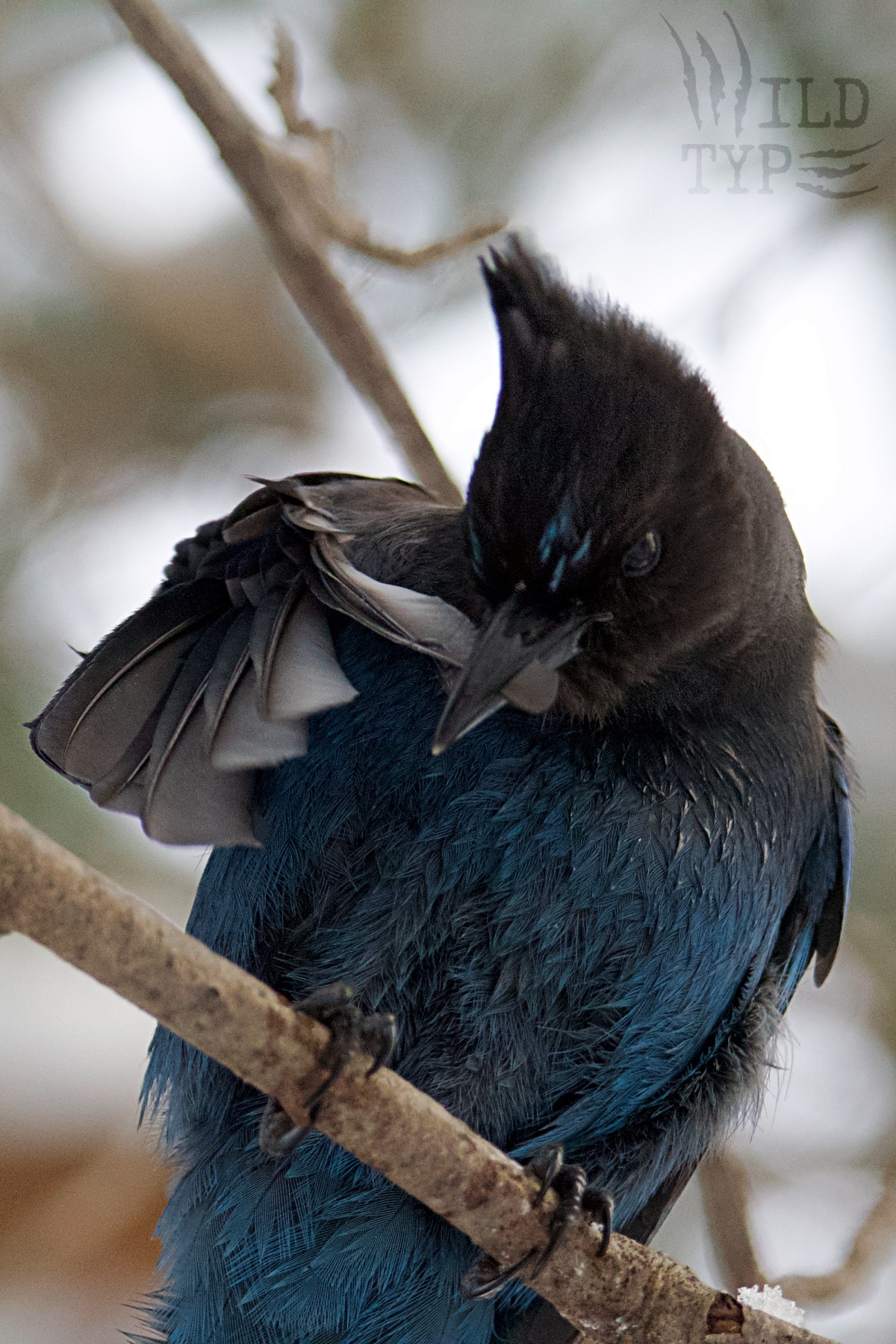
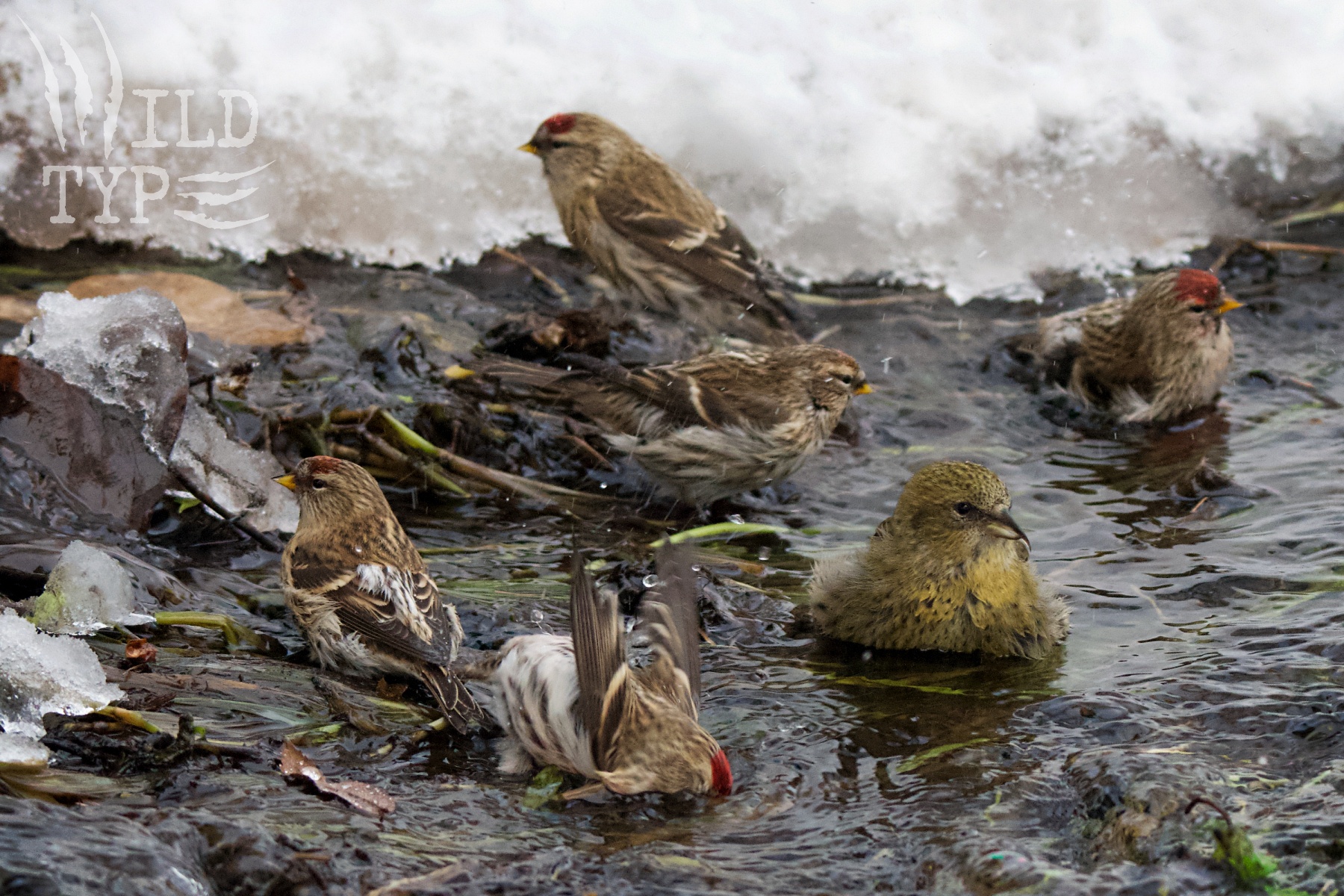
Other species indulged in a more social experience. Further down the creek, I encountered a bird bathhouse. In the shelter of an overhanging bough, a mixed flock of Common Redpolls and White-Winged Crossbills splashed together. A large rock parted the stream’s flow, creating shallow riffles perfect for small birds to frolic. They darted repeatedly between the icy water and the tree, like spa patrons moving between the pool and the lounge. I crouched in the snow, enthralled, for at least ten minutes until most of the birds dispersed to bare branches for grooming, as the jay had. The rest did something I’ve never witnessed in a lifetime of nature observation.
They tunneled into a snowbank.
At first I thought it could be a snow bath, like the raven I’d watched a few weeks earlier. Birds do use snow baths to keep their feathers fluffy and clean, promoting conservation of body heat. But the Redpolls and Crossbills weren’t flapping their wings. They burrowed the way kids (or certain youthfully-spirited adults, ahem) excavate igloos from the plowed-up snow mounds in cul-de-sacs. Periodically a pink head popped up with flakes piled on its beak. Was this part of the hygiene routine? Or something else?
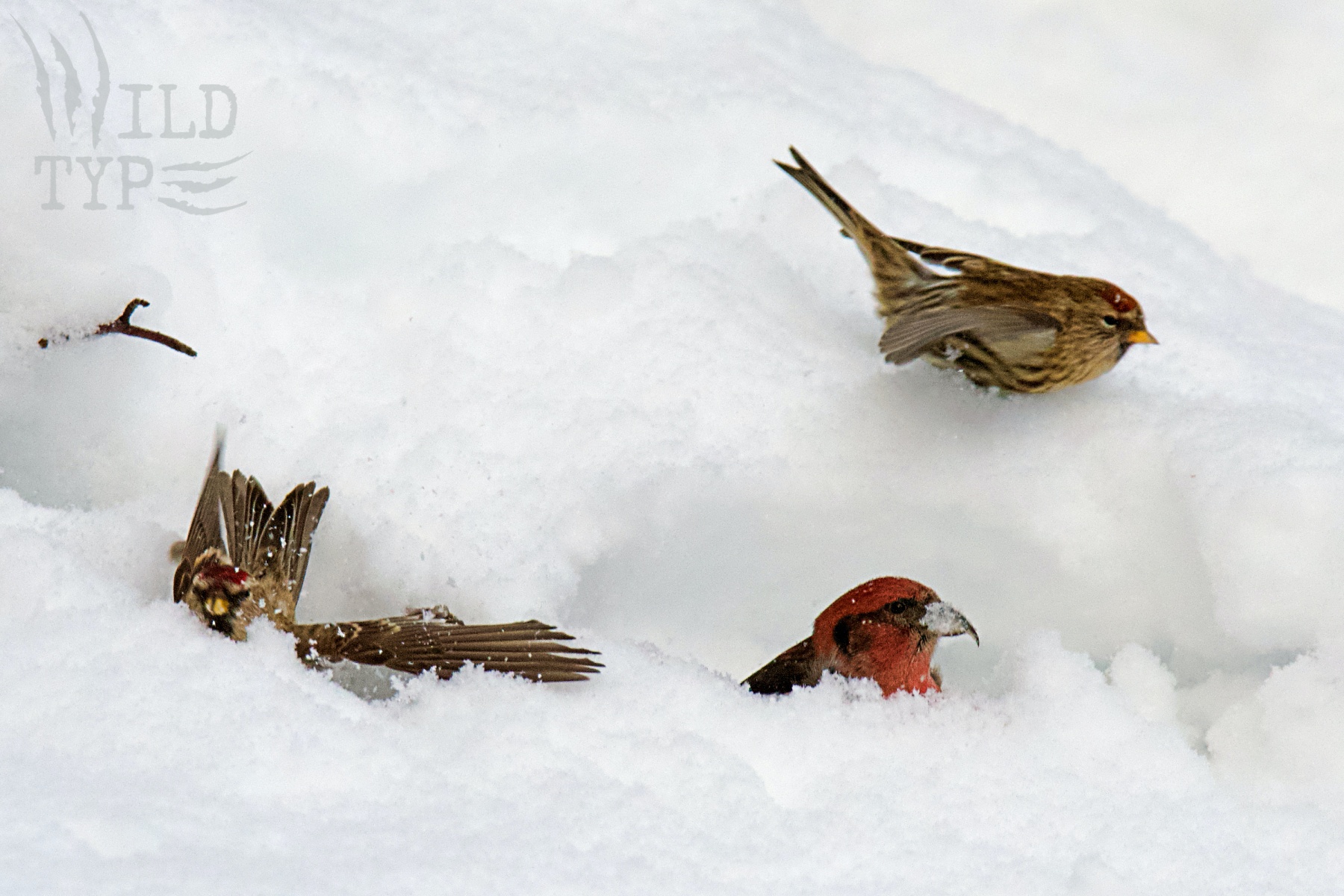
Intrigued, I investigated the topic. Several journal articles examine the phenomenon. First reported in the mid-20th century, researchers have since observed snow frolics among both American and European Redpolls. A 2003 paper in The Kingbird—the journal of the New York State Ornithological Association—distinguished between simple “caves” and longer, horizontal “tunnels” with entrance and exit points. Some of the tunnels measured nearly two feet. The structures held no buried seed, and the birds didn’t sit in their excavated spots for more than a few minutes. Biologist Bernd Heinrich corroborated these observations in 2014:
“One bird after another ducked head first into the snow and then, while fluttering with its wings, it proceeded a few centimeters beneath the snow. Although this behavior looked like the activity typical of bathing birds, it differed in being accompanied by an additional forward locomotion and without repeated head-lifting, subsequent shaking, and feather preening.”
Bernd Heinrich, “Redpoll Snow Bathing: Observations and Hypothesis”
Heinrich explored the possibility that the birds might use the tunnels to escape the cold, which would be a useful adaptation in the high Arctic. However, a 1981 Finnish experiment found that Redpolls didn’t survive more than an hour when kept in snow burrows more than an hour, preferring to huddle together on a perch for warmth. If the tunnels offer no shelter or food, why do birds would expend so much energy on this activity?
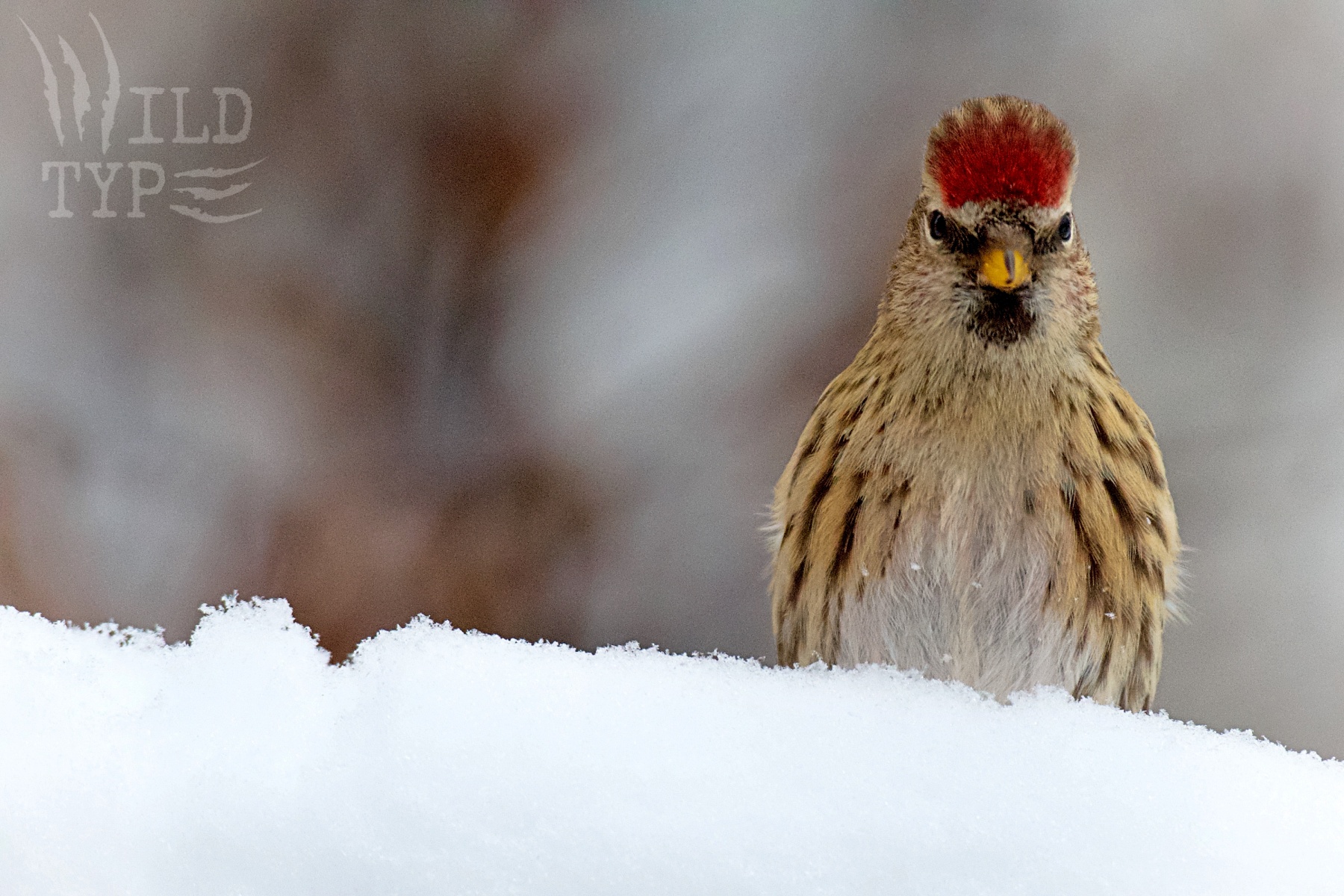
Both Heinrich and the Kingbird study reached the same conclusion: Redpolls play in the snow. “Play is defined as behavior with no immediate function, so in that sense, yes, it is ‘just’ play,” Heinrich told New Scientist magazine. He opined that since multiple birds typically join in the activity, it may serve some social purpose.
But must it? Does it serve a social purpose for humans to go sledding and make snow forts? On a Christmas Eve walk I flopped into a deep snowbank just for the sensory experience, and when last week’s epic storms left a few inches on my parents’ mid-Atlantic lawn, my 73-year-old father made a snowman. Neither of these solo efforts held social value. We embrace our dogs’ and cats’ play so wholeheartedly that the global pet toys market was valued at more than USD seven billion in 2021. Yet we hesitate to acknowledge that wild species (especially non-mammals) engage in similar behavior.
Circumstantial evidence seems obvious to any amateur naturalist. I once watched a Gang-Gang Cockatoo spend twenty minutes manipulating a wing feather he’d shed. He gnawed it, twirled it in his talons, and dangled upside down while waving it like a flag. Watching Redpolls frolic in the snow evoked the same sense of avian amusement. Interestingly, I couldn’t find any reports of Crossbills behaving in this way. Heinrich notes in his paper that other finch species he observed alongside the Redpolls did not tunnel. Could my local Crossbills have adopted the practice through association with Redpolls? I can’t imagine no one ever recorded it before.
Then again, humans have long dismissed the intelligence of birds. In her illuminating book The Genius of Birds, Jennifer Ackerman quotes a neurobiologist who observed that birds’ small brains led many people to view them as “lovely automata capable only of stereotyped activity.” We’re now discovering that bird cognition is far more sophisticated. Perhaps like the concepts of “black joy” and “queer joy”, which denote pleasure in traditionally marginalized ways of being, we should recognize #BirdJoy.
 Wild Type
Lovely thought provoking piece.
LikeLiked by 1 person
Thank you!
LikeLike
This was definitely an interesting read. Nature can still surprise us.
LikeLiked by 1 person
Glad you found the post worthwhile. It’s funny how the more I study nature, the more I realize how little I know about it!
LikeLiked by 1 person