Cold air cleansed my lungs as my crampons bit the ice, hungry for the trail after weeks in the garage. February’s frostbite-inducing temperatures had confined most of my runs to the treadmill’s miasma of rubber and sweat. Once the mercury crept into the teens, I pounced on the opportunity to run outdoors again, inhaling the chrome scent of snow sweetened with pine. The air might not taste so good in a few months. Shortly before I moved to Anchorage last year, smoke from Canada’s devastating wildfires hazed Alaskan skies. With another hot summer forecast—and last year’s fire remnants still burning—2024 could be an even worse year for air pollution.
The climate-risk research group First Street Foundation released a report last month entitled “Atrocious Air”. It found that more than 83 million people across the United States—more than 25% of the population—are exposed to unhealthy air each year. Poor air quality days in the West nearly doubled since the century began, due to the increasing occurrence of wildfires. Over the next 30 years, First Street projects the number of people exposed to “unhealthy” days on the Environmental Protection Agency (EPA) scale will increase by 51%. Populations exposed to “Very Unhealthy” Purple Days and “Hazardous” Maroon Days are expected to increase by 13% and 27%, respectively.
More air pollution means more health problems. Researchers recently determined that inhaling even small amounts of microscopic soot particles known as PM2.5 can increase a person’s health risks. Other medical studies corroborate that finding:
- A study published in the journal of the American Academy of Neurology found a positive correlation between traffic-related PM2.5 pollution and amyloid brain plaque associated with Alzheimer’s disease.
- Analysis of 60 million elderly Americans from 2000 to 2016 found an increased risk of hospitalization for seven major types of cardiovascular disease when participants were exposed to the average levels of PM2.5 found in the U.S.
- Another study published in The Lancet Planetary Health found that breathing in PM2.5 for even a few hours causes more than one million premature deaths worldwide every year, more than a fifth of them in urban areas. Asia and Africa bear the worst effects.
Dire health warnings too often go ignored—just look at COVID-19—so positive political action is a literal breath of fresh air. Last month, the Biden-Harris administration approved stronger air quality standards that will combat PM2.5 pollution, reducing acceptable levels from 12 micrograms per cubic meter to 9. It’s the first improvement on soot regulations in a decade, projected to prevent up to 290,000 lost workdays. Every $1 spent on this initiative could yield $77 in health benefits by 2032. But EPA policies still leave worrisome gaps. Wildfire smoke now contributes a third of all particulate matter pollution, but federal regulators categorize them as “exceptional events” that do not count against air quality goals.
By those skewed measures, Anchorage enjoyed pristine mountain air last summer, even as haze crept over the Chugach Mountains. Data manipulation won’t alter the reality beyond the spreadsheet. Air pollution kills people, productivity, and the planet. That part is simple. Solutions are less so. We can drive less, but not everyone has access to reliable public transportation, and 90% of American companies reportedly expect employees to resume in-office work by the end of this year. Electric cars generate less PM2.5, but become pollution intermediaries unless they draw power from renewable sources. And addressing the climate-change drivers of wildfires demands broad policy shifts. Americans voting this year would do well to consider their candidate’s environmental record, lest they find themselves living in a scenario like this month’s Forecast Fiction.
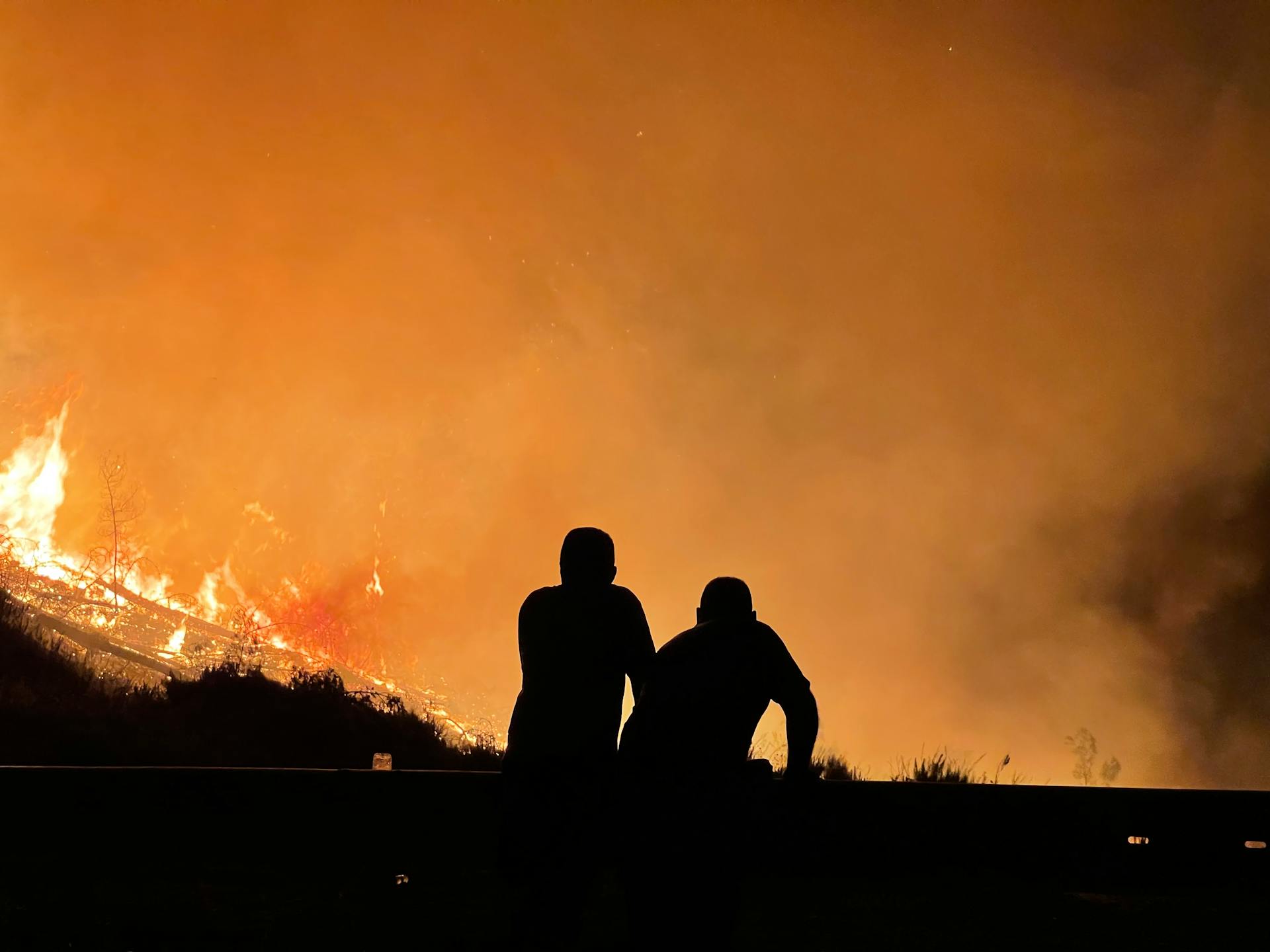
Forecast Fiction
“Where There’s Smoke”
Coughs fracture the telephone hold music burbling through your headset. Springing from your office chair, you tear across the house—-at least, as close to tearing as your chronically weary body can manage. Zephyr hunches over a book on the kitchen table. Every spasm of her tiny ribs resonates in yours.

“Where’s your inhaler?”

She points to her backpack, limp on the floor since the hazardous air alert came out a week ago. You dig through the detritus of a child’s interrupted life: filtration masks, extinct-animal trading cards, a windbreaker ingrained with soot. At the bottom, your fingers brush the metal cylinder. Kneeling beside your daughter, you shove it into her hand. A puff calms her shudders.

“You haven’t had an indoor attack in a while,” you observe, rubbing her back. “Guess I need to check the filter units again.”

She shrugs, but her gaze darts toward the balcony door. Suspicious, you sniff. Your nose hasn't detected a thing since the fateful COVID-19 infection years ago, but the habit persists.

If only my sense of smell were all it stole. Wincing, you approach the door, and your weakened lungs tighten at the air’s foul taste. The door stands ajar. I can’t believe he did it again!

You yank your shirt collar over your face and step onto the apartment’s tiny balcony. The hold music--Vivaldi’s chipper Spring concerto--plays a perverse counterpoint to the smogscape. Ochre plumes swirl over the rooftops. A faint glow in one spot might be the sun. Several feet away, a smaller spark responds.

“Dad! How many times do I have to tell you?”

“I’m doing like you asked! Smoking outside,” he mumbles around his cigarette.

“You also have to close the door.”

“Oh. Right. Bad for the filtration units.”

“And your asthmatic granddaughter!”

“I sweat I shut it.” He flips down the butt and scowls at the door handle. “Maybe the lock isn’t working right.”

Maybe your brain isn’t working right. You catch the bitter words before they pass your lips. If medical evidence couldn’t convince your father-in-law to accept the Alzheimer's diagnosis, scolding him certainly won’t.

It’s not his fault any more than Zeph’s asthma is her fault, your spouse had insisted, tender as always. All those years as a bus driver exposed him to more than his share of traffic fumes. He did his part to support public transit and reduce vehicle emissions, and this is what he gets? It’s wrong, hon. That’s why I’m working so hard on this initiative.

Too hard. Tears prick your eyes, or maybe it’s just the smoldering butt. You grind it out with your shoe; the old man never remembers to do it. “You don’t need a cigarette to fill your lungs with crud, Dad. Just stand here and—-.”

Violins shriek to a halt, and a woman’s voice drips into your ear. “Thank you for holding. How can I help you today?”

Finally! You slip back inside and shut the door. “I’d like to know why my application for relocation assistance was rejected.” You give her the family’s account number with the federal Fresh Air, Fresh Start program.

“Hmm…it looks like your address hasn’t recorded enough Maroon Days over the past year to qualify.”

“Are you kidding? Look at this!” Snatching your phone from the counter, you snap a photo through the window and send it to her.

“I’m sure it looks a little scary, but don’t worry—our calculations rate your neighborhood Purple today.”

“How is that possible? It’s only June, and we’ve already had more wildfires than in all of last year. There’s one in the next county right now that’s burned a thousand acres.”

“Fifteen hundred,” says Zephyr, without looking up from her book.

“Natural disasters aren’t part of our eligibility algorithm," says the representative. "We only count emissions from cars, factories—-you know, things we can control.”

You had a chance to control it, in 2020, when the world stopped short for months. You could have used the global reboot to bring us back smarter and greener. But no, you wanted the lucrative “normal”. And damn me, so did I.

Fatigue weighs on your limbs. You sink into a chair across from Zephyr. “Ma’am, we are a high-risk family. My daughter has asthma. I have a compromised respiratory system from Long COVID. We need to move somewhere with better air.”

“Your local air is better than some places. Traffic emissions in your city have decreased since the start of the year.”

“Because no one can see the street to drive! People can't even breathe outside.”

“Have you received our list of recommended filtration masks?” she chirps. “With the right equipment, you can go about life as normal.”

“Except I can’t see clouds,” Zephyr grumbles, tracing the illustration of a puffy cumulus formation. The tablet at her elbow displays a school assignment on the hydrologic cycle.

“Last time I tried to live ‘normally’, I ended up disabled,” you snap at the representative.

“If you really think moving is the answer, one of our partner banks may be able to arrange a loan.”

“No. We can’t take on more debt.” Without your spouse’s income, medical bills have consumed most of the budget. Only moving in with your father-in-law avoided bankruptcy; his old apartment might be shabby, but it's paid for. “Can I appeal the decision?”

“Of course, but the wait list for review will take an estimated three years to clear.” Shocked silence buzzes on the line. The woman fills it, her voice betraying a hint of apology, “You’d be better off resubmitting your application next year, when the new atmospheric data becomes available.”

Rage tightens your chest further. No point wasting your breath on bureaucrats. You thanks the woman through your teeth and fling off the headset.

Zephyr tosses down her inhaler in mirrored frustration and spins it on the table. “Guess we’re not going anywhere.”

The whirling silver spoke reminds you of hubcaps. Inspiration steals your breath. “Yes, we are. Pack up your school stuff, and some snacks.”

She bounces into action, squirming impatiently beside the door as you and Dad make slower preparations. “Don’t forget your mask, Grandpa!” When his shaky fingers struggle with the loop, she hops onto a chair to help.

You snug your own mask straps, feeling the pinch of irony. If you’d worn one back then, maybe your lungs wouldn’t be ruined now. Your respiratory system can't handle stairs anymore, so the rattling elevator carries you down to the garage.

“What’s in here?” asks Zephyr.

“Our baby before you came along.” You haul the tarp off an electric sports car. Memory changes the concrete backdrop to a coastal highway, a neon skyline, a country road stretching under blue skies. How many joyrides you’d taken together, chasing normalcy…until the one-two punch of Zephyr and Dad’s diagnoses shifted the gears of your spouse’s mind.

They’re sick from the air pollution, hon! Instead of contributing to it, we have to make things better. I applied for an emissions researcher job at that environmental non-profit. I’ll work on an initiative for new regulations…

…And breathe yourself into a heart attack a month after your fortieth birthday. Trying to save others probably killed you. Your hand glides over the hood, smooth and cold as that beloved cheek in the morgue.

“Still don’t know why you didn’t sell this thing,” Dad grunts, folding himself into the passenger seat.

“I thought we might drive it again someday, when the city switched to renewable electricity sources.”

“It’ll be vintage by then.” Zephyr leans over the armrest to fiddle with the radio. “Can I have it when I turn sixteen?”

Let’s get you to sixteen first. The rumbling engine conceals your shudder. Brown haze obscures everything beyond fifty yards; you crawl through traffic lights to the highway and join the luminous chain of taillights. Miles roll on the odometer. Shapes beyond the windshield sharpen.

“Can we stop for a smoke?” Dad asks after an hour.

“We’ll stop when there’s no smoke.”

Another hour takes you up a sinuous mountain road. Dry trees peel back, and Zephyr yelps: “Clouds!”

“What kind?” A grin unfurls behind your mask.

“Um…” Pages turn. “Nimboform! Can I open the window?”

“Why not the door?” You pull into a small parking lot at the overlook. Zephyr tumbles out with a whoop.

Dad exits with a groan and reaches for the cigarette pack in his pocket. “What was the point of driving all the way up here?”

“Enjoying some old memories.” Perching on the car’s hood, you recall your spouse beside you on cool winter nights you’d traveled here for a glimpse of stars. “And making some new ones.”

You watch Zephyr cavort around the overlook. She prattles happily about atmospheric moisture and snaps pictures of the fleecy clouds over the valley. “Most rain comes from these kinds of clouds. Maybe it will help fight the wildfire!”

“Depends on which way the wind is taking them.” You tease out a strand of her hair and let the breeze catch it. “Looks like a good forecast, Dr. Zephyr—-it’s blowing toward the city, and the fire on the other side.”

Her nose wrinkles. “Then why do I still smell the smoke?”

Your dead olfactory sense perceives nothing. “It’s probably just sticking to our clothes.”

She scans the forest behind you and her eyes widen. Dark irises reflect a cloud. A low, vertical cloud.

You whirl around. “Dad!”

He jerks awake from a nap in the front seat. “Huh?”

“Did you remember to put out your cigarette?” You stagger toward the woods, roiling with bluish-white smoke. “I’ve told you a hundred times not to throw butts on the ground!”

You stamp on a few embers, but flame already licks the dry bracken. Zephyr hurries over to help. Smoke engulfs you both. Coughing, you pull your daughter back to the car.

Dad stares stricken through the back window. “I stepped on it, I swear. I think.”

“It doesn’t matter now. I need to step on it. Call the fire service.” You toss your phone into his lap, yank on your seatbelt, and career back down the mountain.

Hold music tinkles through the speaker for the second time that day. Dad curses. “They must be busy with the other wildfire."

“We’re gonna be a smoke sandwich!” Zephyr scrubs at her soot-reddened eyes. “I’ll never see the clouds again!”

You might never see anything else. Filthy carbon clouds billow in the rearview mirror. Knuckles white on the wheel, you race toward the rapidly dimming horizon.
 Wild Type