Too often I forget that Nature is more than a postcard: an exotic destination like jungles, deserts, or coral reefs. It’s not a place we visit, but a realm we inhabit. Environmental phenomena can whisk us on journeys even in the humblest urban landscape. Still we chase the thrill of terra nova, like earlier this month when I badgered my Laddie for a day hike in the mountains around Anchorage. Surrounded by grimy street snow, I fantasized about snowy alpine vistas. But since his ACL repair surgery, he’s (very understandably) leery of unfamiliar and icy terrain. Instead, he lobbied for a few easy loops around our neighborhood lake. I might have scoffed, except I had a ulterior motive for exploring that day: citizen science.
The Great Backyard Bird Count, a crowdsourced program sponsored by Cornell University and the National Audubon Society. People around the world submit counts of local birdlife. The data helps scientists track biodiversity, population changes, and shifts in species’ range. My family participated back in the 90s: Mom would tape a paper tally sheet to the kitchen window and, after four days of dedicated pencil marks, submit the results via mail. Now there’s an app for that, and nerds like me use it all year round. Even with digital assistance, it’s hard count birds while watching my feet on a treacherous trail. Thus, in the name of science, I agreed to my Laddie’s tame route.
It’s amazing how much we see when we actually look. Approximately 65 mallard ducks crammed into a small unfrozen corner of the lake, with two common mergansers hiding in the throng. At least 20 common redpolls flitted around a stand of bare birches. Eight black-capped chickadees sang in the spruces. Pairs of nuthatches, magpies, blue jays, and ravens zipped overhead. Only one of the usual bald eagle pair appeared, perched imperiously atop a distant tree. Nonetheless, it was a good survey for a cold, dim day. Satisfied, we headed back.
My Laddie nodded up the path. “That’s a lot of birds.”A flock filled the canopy, wings fluttering on the bare branches like out-of-season leaves.
“Probably starlings,” I replied. But as we approached, high-pitched trills zipped past my ears, reminiscent of cartoon laser fire. Black eyes gleamed behind black masks. “Wait—waxwings!”
I last saw the genus Bombycilla—named from the Latin word for silk, in reference to their sleek feathers—in 2020, when my Laddie and I awaited permission to complete our move to Australia. Deep into a local park, we encountered a flock of cedar waxwings bathing in a brook. Waves of birds flowed between the water and the branches overhead. Now their Alaskan cousins the Bohemian waxwings did the same dizzy dance, descending on the roadside trees to gobble shriveled berries.
Sugary fruit constitutes most of waxwings’ diets. A flock can strip a tree in a few hours. Since they swallow food whole, they prefer softer fruits, and may test a site every few weeks until freeze and thaw cycles tenderize the harvest. Large livers help the birds metabolize the alcohol in fermented fruit (although they can still become intoxicated). Roving in search of food earned them the name “bohemian”. Waxwing is similarly literal: seventeenth-century ornithologists thought the red-tipped secondary feathers appeared to have been dipped in sealing wax. These pigmented cuticles change color with maturity. Researchers in the 1980s hypothesized that the birds use them to pair up with mates of similar age.
Although their hues are less vibrant in winter, the waxwings still made a brilliant display. Transported, I swung my camera lens between vignettes. A berry disappeared down a bird’s gullet before it hopped off to another spot. Two—now three, now four—birds crammed together on a branch like regulars at a neighborhood bar, drunk on shriveled fruit. Every few minutes the shift changed. High-perched birds descended to feed, while the diners took up sentry posts. The frenzy spun me around in the snow, breathlessly switching tableaux.
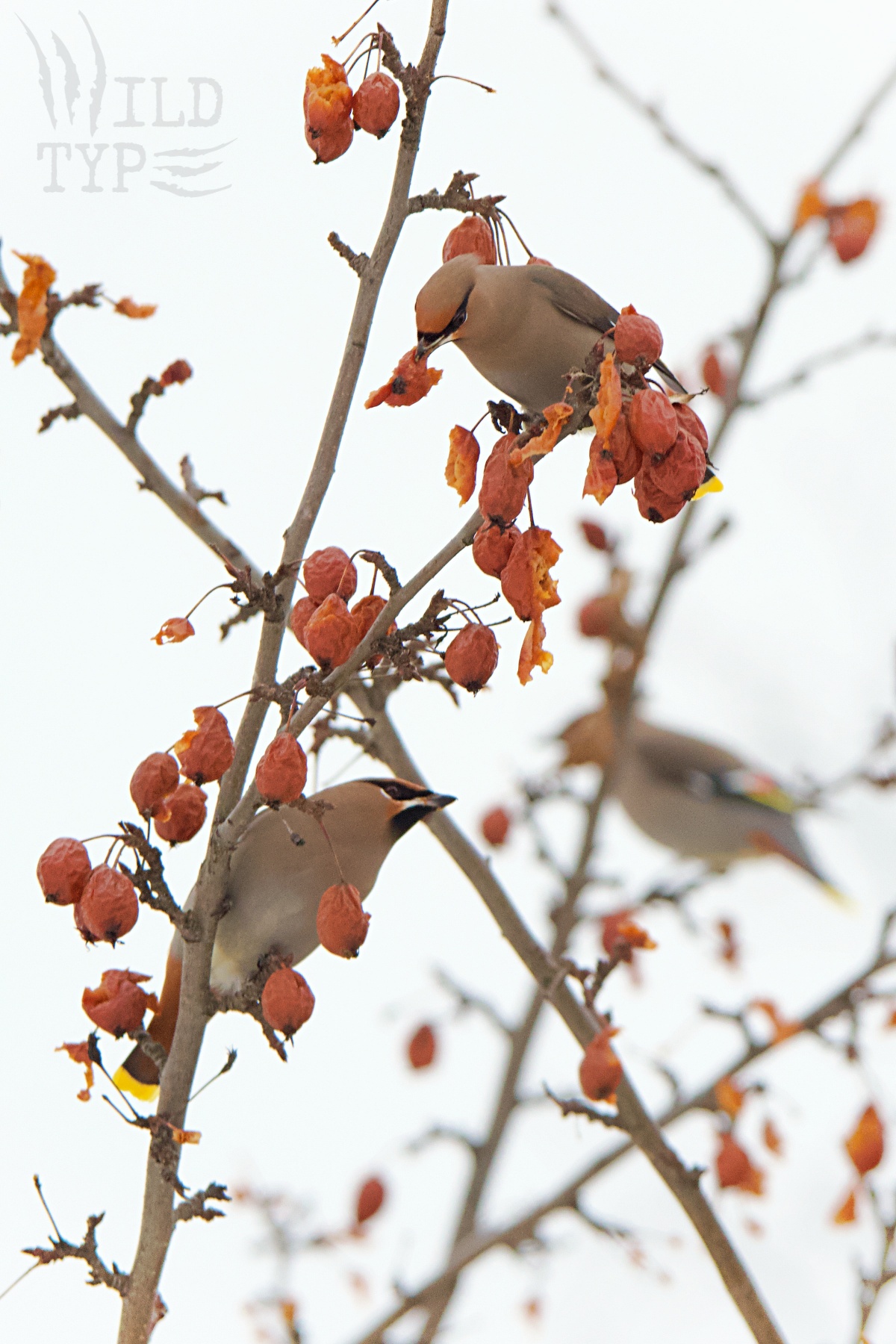
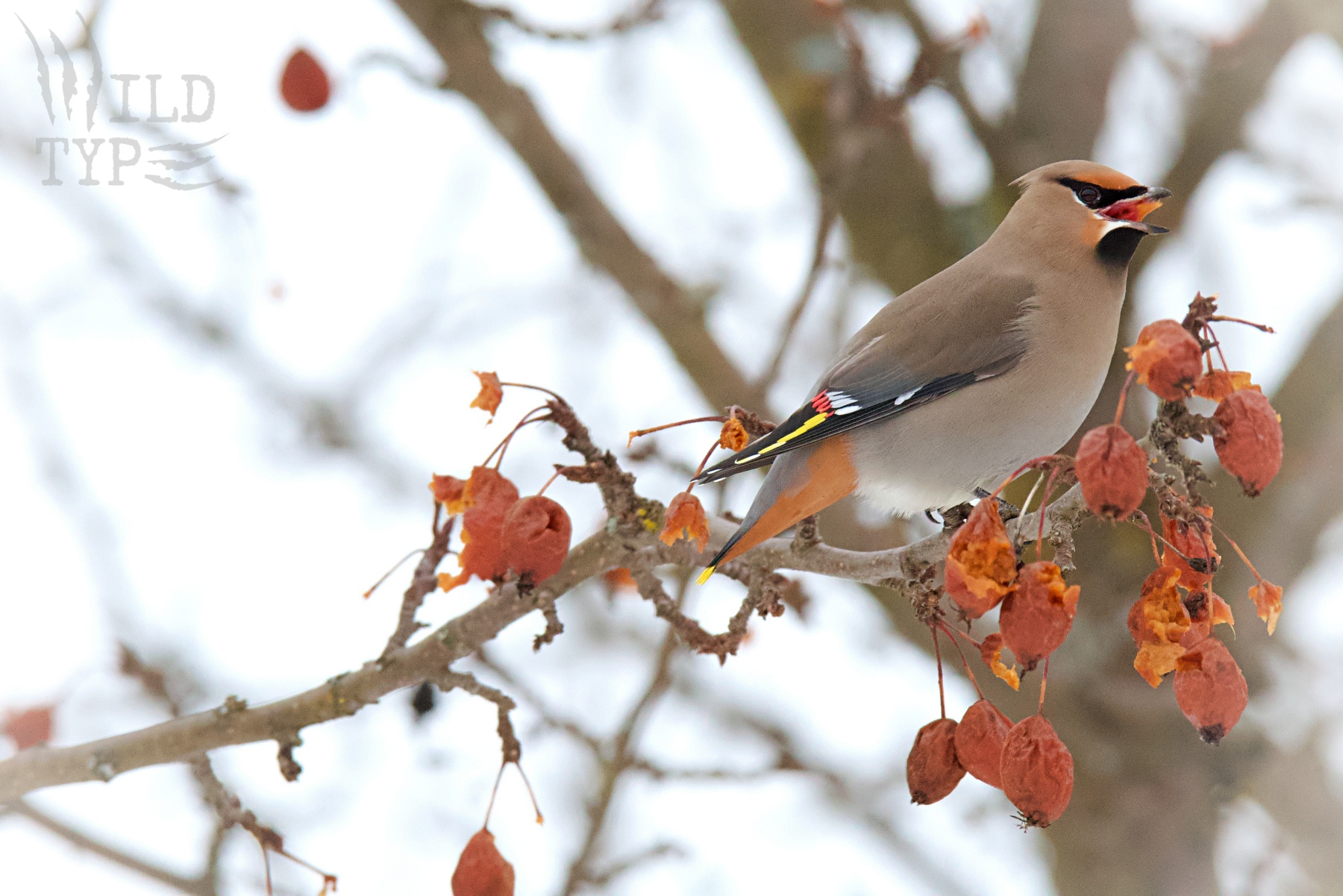
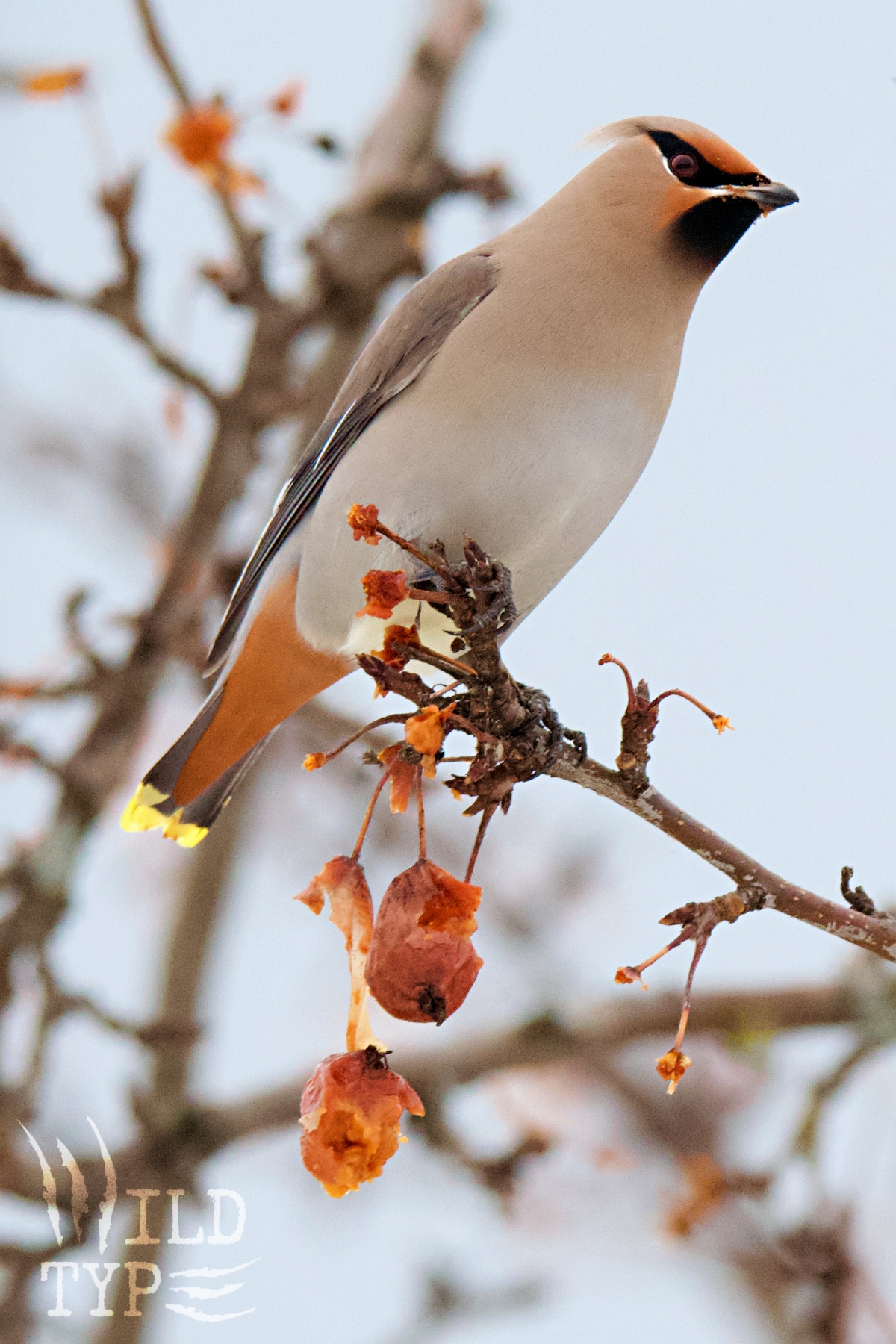
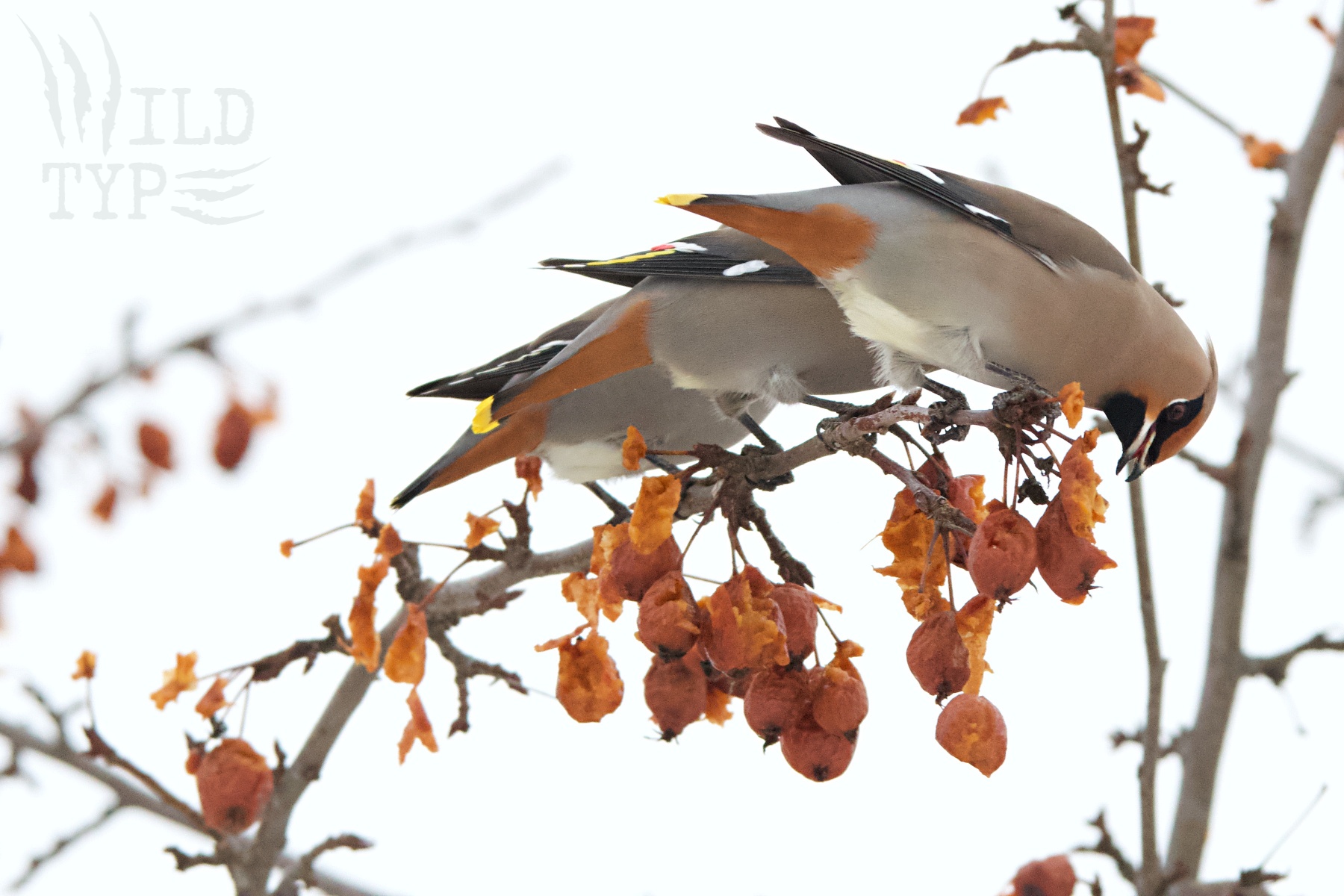
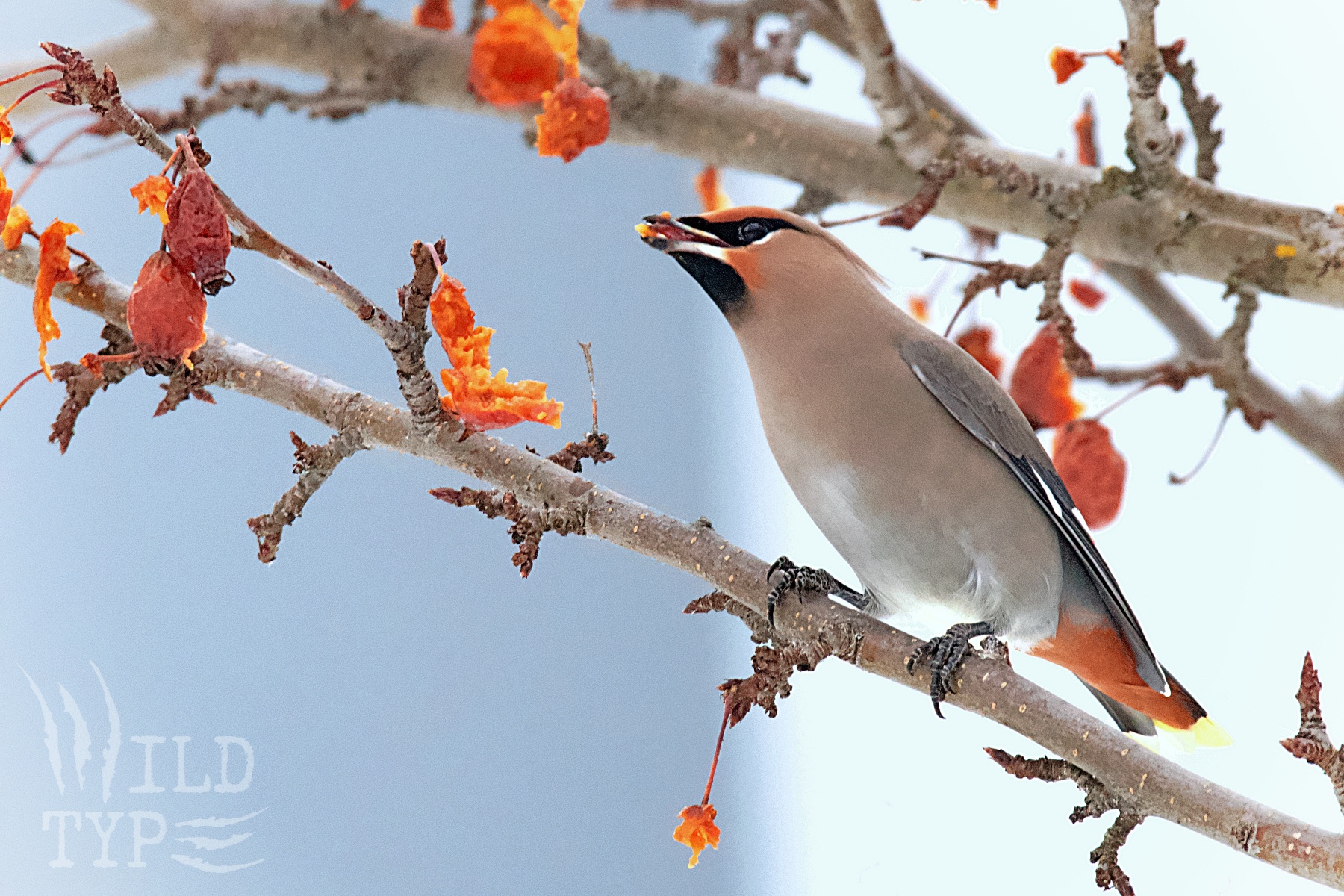
Subjects silhouetted against a grey sky aren’t ideal, but wildlife photographers don’t choose the lighting in their studios. We work with whatever nature gives us. My shutter chittered along with the birds. Unlike most passerine birds, waxwings do not sing. This may be because short calls make more effective communication in large social groups, or because waxwings use their brain resources for memorizing food geography instead of a musical repertoire. Yet they do not lack lyricism. Their motion created a visual poetry: extension of neck, folding of wings, moving en masse between trees. My own movement expressed far less grace, skidding around the sidewalk to photograph the spectable.
Click. Click. WHOOSH. The snap of compressed air from five hundred wings echoed like a miniature sonic boom. Triggered by some signal imperceptible to my human senses, the flock took off, leaving me dazed and delighted. Icy pavement firmed under my boots again, as if I’d just touched down from a swift flight myself. The murmuration swirled over the rooftops, then coalesced into a feathered cloud and headed south. I took a final shot; later, loading the image onto my computer, I counted specks against the grey clouds. My GBBC data concluded with 253 Bohemian Waxwings.
That sounds like a lot, but Bohemian Waxwing populations in North America have declined by 55% since 1970. The fruiting trees they forage are often near buildings and roadways, making the birds susceptible to collision with windows and cars. Pesticides applied to the fruits may also affect them. In a troubling twist, the birds’ vagrant nature makes it hard to evaluate how at-risk the genus might be. Despite spending most of my life within range of some waxwing species, I’ve only seen them a handful of times.
But I remember every one. There’s an evanescent magic to a waxwing flock. Unexpected as a shaft of sunlight on an overcast day, they dazzle us with a few bright moments, then vanish. What if they never came back? What wondrous travels we’ll miss if these vagabond birds send us a postcard from the dark realm of extinction! Then, walking beneath the silent fruit trees, we will be the ones to say “wish you were here”.
 Wild Type